
 en
en
CS2 Wingman Explained: All Ranks, How the System Works, and Climbing Tips

Counter-Strike 2’s Wingman mode offers a fast-paced 2v2 competitive experience built on the same ranking framework as standard Competitive matchmaking. Players can progress through 18 total ranks – from Silver I to Global Elite – with consistency, smart play, and strong coordination with a teammate.
Yet many players also report that the Wingman ranking system can feel inconsistent. This guide breaks down exactly how CS2 Wingman ranks work, how placements are determined, and how to climb efficiently.
|
Tier |
Ranks |
|
Silver (Beginner – Early Intermediate) |
Silver I Silver II Silver III Silver IV Silver Elite Silver Elite Master |
|
Gold Nova (Intermediate) |
Gold Nova I Gold Nova II Gold Nova III Gold Nova Master |
|
Master Guardian (Advanced) |
Master Guardian I Master Guardian II Master Guardian Elite Distinguished Master Guardian |
|
Elite (High Rank) |
Legendary Eagle Legendary Eagle Master Supreme Master First Class |
|
Peak Rank |
Global Elite |
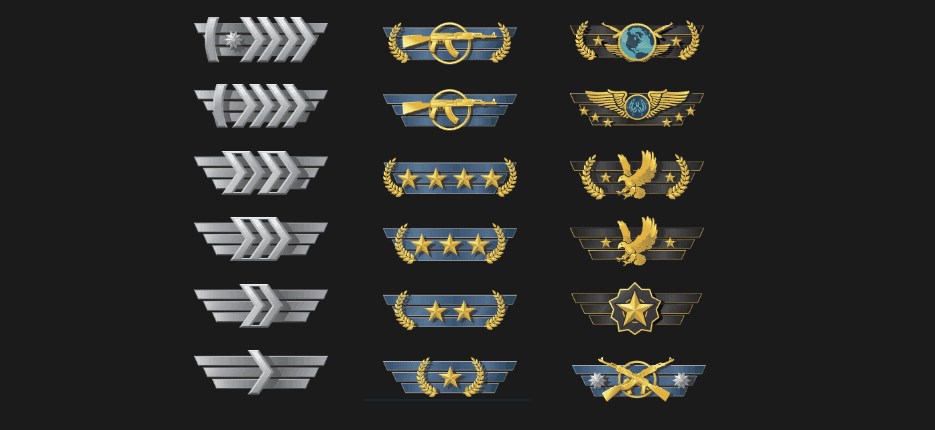
The progression from Silver to Global Elite represents increasing skill requirements, tactical awareness, and consistency in 2v2 matches. Unlike Competitive mode where ranks are map-specific, Wingman rank is a single unified rank across all Wingman maps.
Community data suggests that approximately 55% of players occupy Silver through Gold Nova ranks, 30% sit in the Master Guardian range, 12% reach Legendary Eagle through Supreme, and fewer than 3% achieve Global Elite.
How Wingman Ranks Are Determined
The CS2 Wingman ranking system operates on a hidden matchmaking rating (MMR) that players cannot directly see. Your visible rank is determined by this underlying score, which adjusts after every match based on multiple performance factors. The system uses Elo and Glicko-2 rating algorithms – the same foundational approach as traditional competitive matchmaking – to evaluate your skill level relative to opponents.
Key Factors That Influence Your Wingman Rank:
- Match Outcomes – Wins increase your MMR; losses decrease it. The magnitude of change depends on opponent rank and your performance metrics.
- Opponent Skill Level – Defeating higher-ranked players generates significantly more MMR gain than beating lower-ranked opponents. Conversely, losing to lower-ranked teams results in steeper MMR penalties.
- Individual Performance – Kills, MVP awards, clutch round wins, and overall round impact contribute to MMR calculation. Strong individual stats combined with a win accelerate rank progression.
- Consistency and Activity – Regular play stabilizes your rank, while extended inactivity can increase rating deviation and lead to more volatile rank changes.
Wingman ranks are completely independent from Competitive and Premier modes. Your Competitive map-based ranks, Premier rating, and Wingman skill group all progress separately and do not affect each other. This separation allows players to maintain distinct skill profiles across different competitive formats.
Placements: How to Get Your First CS2 Wingman Rank
To get your first Wingman rank in CS2, you must win 10 placement matches, which the system uses to gauge your initial 2v2 skill. Across these games, it evaluates your wins, individual impact, and opponent strength to calculate starting MMR and assign a rank.
After placements, your rank can change after every match, with each win or loss shifting your hidden rating based on performance and enemy quality. Early on, expect bigger swings as the system refines your estimate. Playing regularly with the same teammate helps stabilize results and reduce extreme rank volatility.
Tips to Rank Up in Wingman
Climbing the Wingman ranks requires a different approach than traditional 5v5 Competitive play. With only two players per team, individual impact is magnified, and team coordination becomes even more critical. Below are practical strategies and common mistakes to avoid.
Core Climbing Principles
-
Play with a consistent duo partner
-
Queue with the same teammate to build synergy and trust.
-
Develop set plays, understand each other’s tendencies, and predict rotations together.
-
Stable duos usually climb faster and experience less rank volatility than solo/rotating partners.
-
Maintain a winning mindset
-
Aim for roughly a 60% win rate over time for consistent rank gains.
-
Review why you are losing (map, roles, duels, economy) instead of spamming more games.
-
Treat losses as feedback and adjust your play and game plan accordingly.
-
Economy and buy patterns in Wingman
-
Manage money tightly because there are only two players and fewer rounds.
-
Coordinate buys so both players have comparable weapons and utility.
-
Pistol round discipline
-
Treat pistol rounds as high-impact; coordinate buys and roles.
-
Avoid uneven buys where one player is heavily geared and the other underbought.
-
Decide your post-plant/retake plan before the round starts.
-
Know when to save vs buy
-
If your combined money is weak, full-save together for a proper buy next round.
-
Avoid greedy double-AWP or half-buys that leave you under-equipped.
-
Reward round management
-
Use the standard $2,400 win reward to plan follow-up buys and anti-ecos.
-
After losing the opener hard, consider a full save instead of a low-utility force.
-
Communication and trading fundamentals
-
Always aim to trade your teammate’s death quickly.
-
Take fights where you can peek together or swing off each other.
-
Play in your partner’s pocket
-
Stay close enough (roughly 5–10 meters) to trade instantly.
-
Avoid overextending alone where you can be isolated and picked.
-
Coordinate utility usage
-
Plan smokes, flashes, and molotovs before the round starts.
-
Use utility to take space, deny pushes, and isolate duels instead of dry-peeking.
-
Sync your utility so you hit sites/angles together rather than one by one.
Consistency Habits
-
Establish a warmup routine
-
Spend 10–15 minutes on aim training before each Wingman session.
-
Focus on close-range spray control and spray transfers on workshop/aim maps.
-
Play 3–5 focused matches per session
-
Prioritize quality over volume; avoid marathon 10–15 game grinds when tired.
-
Expect decision-making and mechanics to drop off after 4–5 games due to fatigue.
-
Review your losses
-
After each loss, quickly identify key issues: enemy utility, economy mistakes, or miscommunication.
-
Note patterns and adjust next games to avoid repeating the same errors.
Common Wingman Climbing Mistakes
-
Playing with different partners every session (prevents synergy and consistent data gathering)
-
Ignoring economy discipline (buying individual items that don't align with your partner's equipment)
-
Overcommitting to wide positions (leaves your partner unable to trade your death)
-
Skipping utility in early buys (smokes and flashes win rounds, kills do not)
-
Playing too many maps (dilutes map knowledge and creates decision fatigue)
-
Grinding long sessions when fatigued (leads to poor positioning and missed shots)
-
Obsessing over ranks rather than controllable performance metrics
-
Queuing alone or with rotating partners (prevents partner synergy)
Tracking Your Progress: Leaderboards and Stat Sites
Understanding your progress goes beyond your visible rank. Several community tools and leaderboards help you contextualize your skill level and identify improvement areas.
csstats.gg Wingman Leaderboard
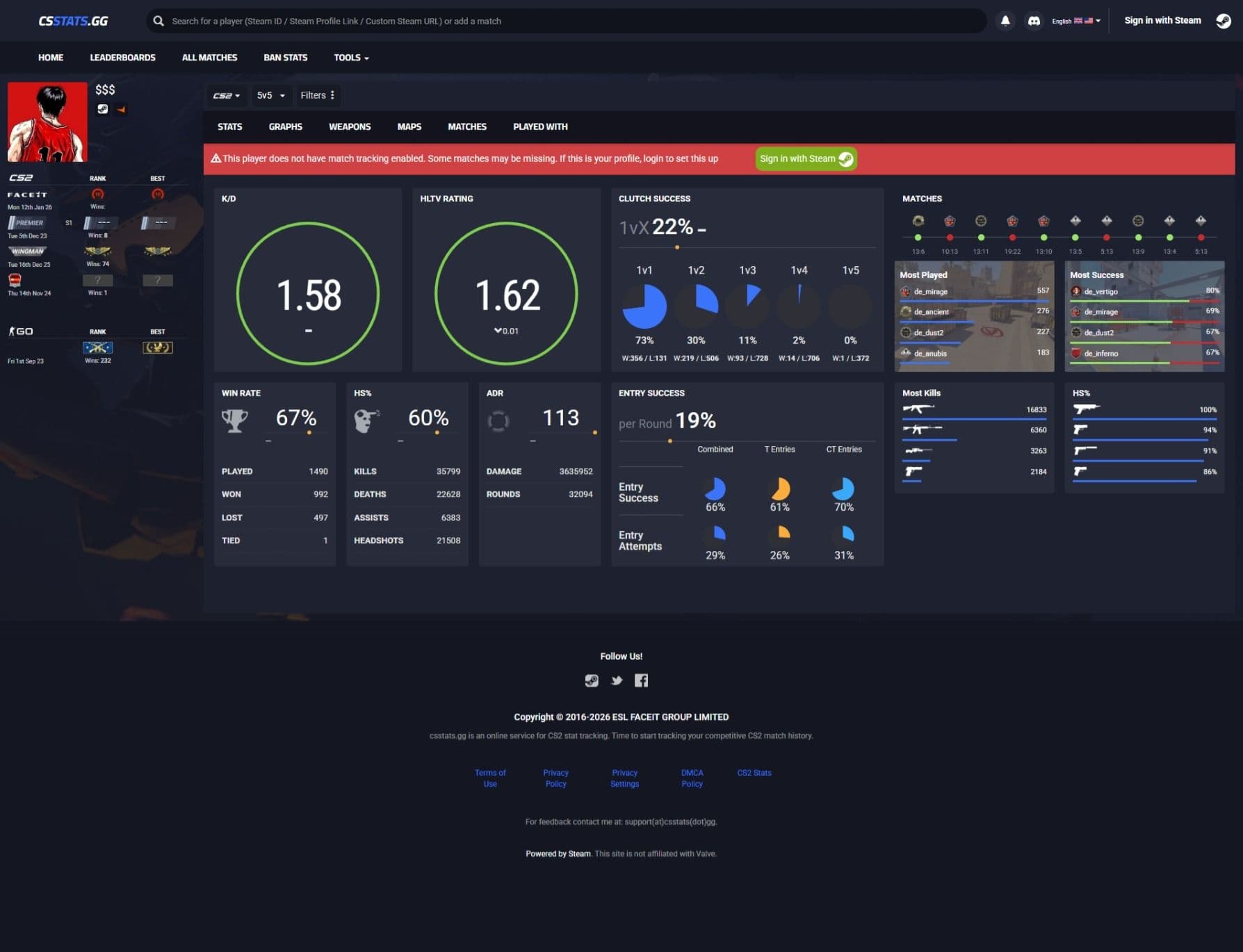
The primary community resource for Wingman statistics is csstats.gg, which hosts a Wingman leaderboard showing rank distribution, player ranking percentages, and comparative statistics. This leaderboard reveals what percentile your rank represents. For example, Legendary Eagle ranks in the top 12.59% of players, while Distinguished Master Guardian sits in the top 17.87%.
What Leaderboards Show and Don't Show:
Leaderboards provide rank distribution data and allow you to see where your rank sits relative to the overall player base. However, they do not track individual match histories, kill-death ratios, or other granular performance metrics for Wingman specifically, as Valve does not expose comprehensive Wingman statistics to third-party trackers. This contrasts with Premier mode, where detailed rating and match data are publicly available.
Using Stats Without Obsessing
While it's useful to check that you're progressing (moving from Silver to Gold, Gold to Master Guardian, etc.), avoid obsessing over exact percentiles. Leaderboard data shows only rank—not game sense, consistency, or actual skill trajectory. A player ranked in the top 20% today may be top 15% next month due to natural fluctuations and improved play.
Using Stats to Improve (Not Obsess)
Track three metrics to gauge actual improvement:
- Win Rate Over Last 20 Games – Are you maintaining 60%+? If not, identify the common factor (specific maps, opponent types, economy failures).
- Consistency – Are you playing the same maps and with the same partner? Consistency stabilizes your rating and provides cleaner data.
- Rank Progression Timeline – Did you advance from Silver IV to Gold Nova I in 40 games? That's measurable progress. Don't compare your Wingman rank to your Competitive rank—they're separate skill assessments.
Is the CS2 Wingman Rank System "Broken"?
A common complaint in the CS2 community is that Wingman ranking feels inconsistent or "broken." Players report scenarios like winning 80% of placement matches with a consistent partner yet receiving vastly different ranks, or experiencing long win streaks with no rank advancement followed by a single loss that causes demotion. Understanding what causes these perceptions is important for managing expectations.
Why Players Think Wingman Ranks Changed in CS2
-
Smaller player pool
-
Wingman has fewer active players than 5v5, so the system has less data and “anchors.”
-
This leads to more noticeable rank swings and occasionally odd-feeling promotions/demotions.
-
Invisible MMR changes
-
Wingman relies on hidden rating, so you never see the exact points gained or lost.
-
You can win and gain MMR without ranking up, or lose with only a tiny rating drop, which feels inconsistent.
-
Placement inconsistency perception
-
Strong stats or an 80% win rate in placements do not guarantee a high starting rank.
-
The system weighs the actual strength of opponents more than raw win–loss numbers.
-
Glicko-2 rating deviation
-
The rating model tracks both your skill estimate and how “certain” it is.
-
Early on, high uncertainty makes ranks swing more; after more games, rank changes stabilize as the system gains confidence.
Practical Steps If Your Rank Changes Seem Inconsistent
-
Play more games to stabilize
-
Expect higher volatility in roughly your first 20–30 Wingman matches after placement.
-
As you log more games, the system refines your skill estimate and rank swings tend to smooth out.
-
Track match results
-
Keep a basic log of wins, losses, and visible opponent ranks.
-
After ~20 games, review patterns to spot issues like struggling versus certain ranks or playstyles.
-
Play with a consistent partner
-
Duoing with the same teammate gives the system a clearer picture of your true 2v2 level.
-
Constantly changing partners adds noise, making your performance and rating harder to interpret.
-
Focus on controllable variables
-
Aim for around a 60% win rate over time.
-
Stick to 1–2 comfort maps, coordinate economy decisions, and only grind when warmed up and focused.
If you maintain these habits and your rank still doesn't improve, the data suggests a genuine skill ceiling rather than a system issue.
FAQ
Q. How many Wingman ranks are there in CS2?
A. 18 skill groups total.
Q. What is the highest Wingman rank in CS2?
A. Global Elite.
Q. How do you get your first Wingman rank in CS2?
A. Win 10 placement matches.
Q. Are Wingman ranks the same as Competitive ranks in CS2?
A. Yes, they have identical names and structure.
Q. Why does CS2 Wingman ranking feel broken?
A. Volatility from small queues and updates causes perceived swings. Playing more games should stabilize this feeling.